

Is a Tankless Water Heater Worth the Cost in 2026?
Last Updated: November 2, 2026
Quick Summary
A tankless water heater is often worth the cost, but only when the numbers fit your household. You pay more upfront for the unit plus gas-line, venting, and sometimes electrical work, while long-term savings come from heating water on demand instead of keeping a tank hot all day.
Payback depends on hot-water demand, fuel type, and local utility rates.
Tankless units deliver continuous hot water, free up floor space, and often last longer.
Storage-tank models cost less upfront and install with fewer modifications.
In hard-water areas, tankless units need descaling maintenance.
Size by temperature rise, not just flow rate, to avoid cold showers in winter.
Table of Contents
Tankless Water Heater Cost: Upfront Price vs. Long-Term Savings
Is a tankless water heater worth the cost? Often yes, but only when the numbers fit your household.
The upfront price runs higher than a storage-tank unit, covering the unit plus gas-line capacity work, venting, and sometimes electrical upgrades, where budgets surprise people.
Long-term savings come from lower energy consumption, since a tankless unit heats water on demand instead of keeping a tank hot all day. The U.S. Department of Energy guidance on water heating notes water heating is one of the largest energy expenses in a typical home, which is why efficiency gains matter.
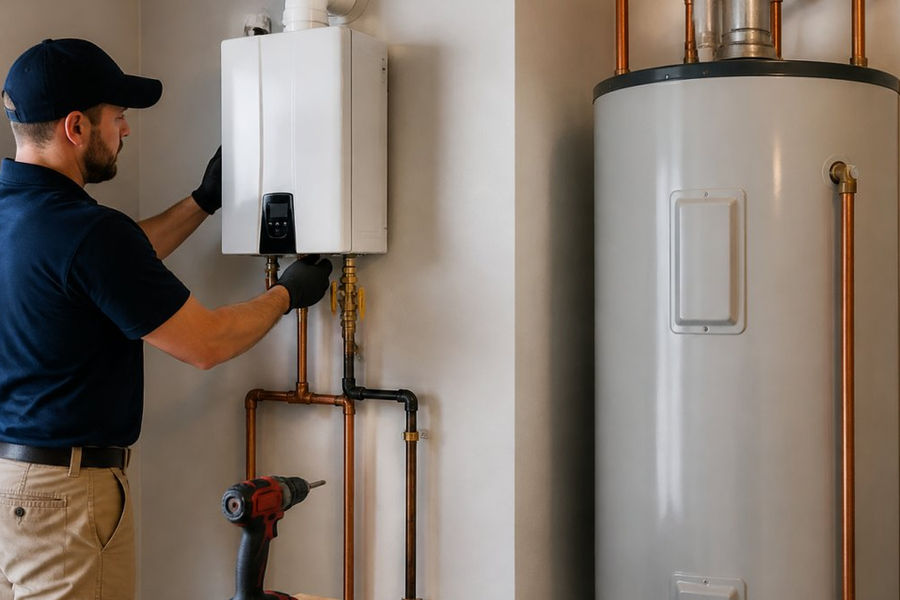
Payback depends on hot-water demand, fuel type, and local utility rates.
Tankless vs. Tank Water Heater: Which Fits Your Home?
A tankless water heater heats water only when you turn on a tap, while a storage-tank water heater keeps a full tank hot around the clock.
Tankless units deliver continuous hot water, free up floor space, and often last longer, but cost more and demand stricter installation. Tank models cost less upfront and install with fewer modifications, but suffer standby heat loss and a limited supply.
Factor | Tankless | Storage Tank |
Upfront cost | Higher | Lower |
Continuous hot water | Yes | Limited by tank size |
Space needed | Compact, wall-mounted | Floor space required |
Tankless Water Heater Pros and Cons for Homeowners
Homeowners gain continuous hot water, space savings, and often lower energy bills. The cons deserve equal billing: higher upfront cost, possible gas-line, venting, or electrical panel upgrades, and descaling maintenance in hard-water areas.
Cold-climate performance matters too: colder winter groundwater makes the unit work harder, so sizing by temperature rise, not just flow rate, prevents the "cold shower surprise" when two fixtures run at once.
For a professional assessment and installation, explore our plumbing services.
Frequently Asked Questions
Why are plumbers against tankless water heaters?
Many plumbers warn about tankless units because installation often requires gas-line upgrades, new venting, or electrical work that adds to the tankless water heater cost. In older homes, the retrofit can be extensive. A reputable contractor will assess your fuel type, venting, and electrical capacity before recommending one, so you know the full scope rather than discovering hidden costs later.
Does a tankless water heater make your electric bill go up?
An electric tankless unit can draw significant power during use, and if your home needs an electrical panel upgrade, that adds to the upfront cost. However, because it heats water only on demand, it avoids the standby heat loss of a storage-tank water heater. Actual energy savings depend on household size, hot-water demand, and flow rate, so ask for a usage-based estimate before you buy.
How long does a tankless water heater last?
Most tankless water heater lifespan estimates run longer than traditional storage-tank models, but hard water shortens that life without regular descaling. Annual maintenance and a water softener where needed protect the heat exchanger. When comparing tankless vs. tank water heater options, factor in maintenance to get a fair picture of long-term value and payback period.
The right call comes down to your household's hot-water demand, your home's fuel setup, and how long you plan to stay. Choctawhatchee Plumbing installs, repairs, and maintains both tankless and traditional water heaters, with energy-efficient upgrades and honest system assessments backed by our CMC 057103 and CFC 1433333 licenses. Call today to schedule your evaluation and get a system sized for your home.
Comments